Uncertainty reigns in Fashion for 2024
In 2022, the fashion industry again showed its resilience, almost equaling the record economic profit of 2021, the luxury sector outperformed, with a 36 percent rise in economic profit that offset weakness in other segments. Yet even the non-luxury sector was ahead of its long-term average. Strong margin performance meant the industry in 2022 achieved more than double the economic profit than in all years between 2011 and 2020, except for one.
In 2023, Fashion industry faced challenges that were both persistent and deepening. On a regional basis, Europe and the United States saw slow growth throughout the year, while China’s initially strong performance faded in the second half. Though the luxury segment initially fared well, it too began to feel the effects of weaker demand in the latter part of the year, leading to slowing sales and uneven performance.
According to a Mc Kinsey survey looking to 2024, the most prominent sentiment among fashion industry leaders is uncertainty, reflecting the prospect of subdued economic growth, persistent inflation, and weak consumer confidence. Against this backdrop, businesses will be challenged to identify pockets of value and unlock new drivers of performance.
The global industry will post top-line growth of 2 to 4 percent in 2024 (exhibit), with regional and country-level variations. Once again, the luxury segment is expected to generate the biggest share of economic profit. However, even there, companies will be challenged by the tough economic environment. The segment is forecast to grow globally by 3 to 5 percent, compared with 5 to 7 percent in 2023, as consumers rein in spending after a post pandemic surge. European and Chinese growth is set to slow, while US growth is expected to pick up after a relatively weak 2023, reflecting the slightly more optimistic outlook there.
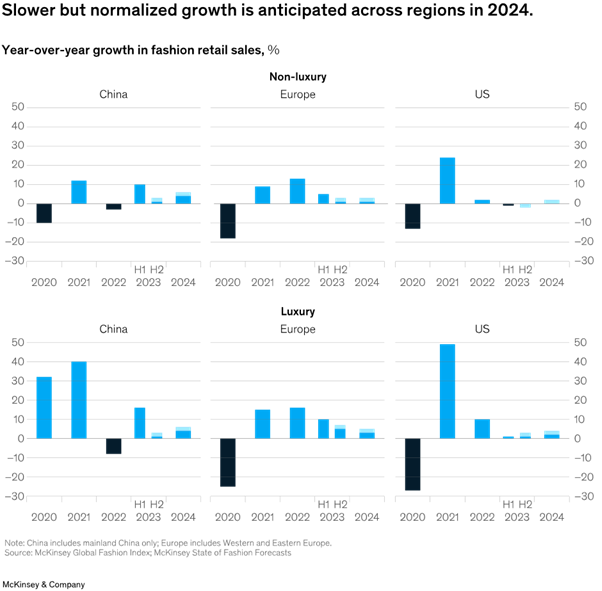
The European market will likely expand by just 1 to 3 percent, compared with 5 percent in the first half of 2023 and 1 to 3 percent in the second half. Slumping consumer confidence and declining household savings are expected to be the most probable causes of restrained spending. In the United States, nonluxury sector growth of 0 to 2 percent is forecast. And China is expected to be similarly challenged amid 4 to 6 percent growth, which is a slight uptick from the end of 2023 but slow when considered on a historical basis. Uncertainty within industry reflects the broader economic situation, albeit with regional divergence. Going into 2024, pressure on household incomes is expected to dampen demand for apparel and prompt trading down across categories. Still, there are geographic outliers that may offer comfort. One is India, where consumer confidence hit a four-year high in September 2023.
2024 key issues
A key theme will be companies keeping a firm grip on costs and inventories while driving growth by precisely managing prices. Brands and suppliers can expect an increasingly competitive environment. But they will also have opportunities, with consumers discovering new styles, tastes, and priorities—all presenting routes to value creation.
- Global economy:
- Fragmented future. In 2024, the global economic outlook will continue to be unsettled, as financial, geopolitical, and other challenges weigh on consumer confidence. Fashion markets in China, Europe, and the United States will likely face headwinds, some of which reflect individual regional dynamics. Suppliers, brands, and retailers may need to bolster contingency planning and manage for uncertainty.
- Climate urgency. The frequency and intensity of extreme weather-related events in 2023 mean the climate crisis is an even more urgent priority than in previous years. With physical and transition risks rising across continents, the industry must not delay in tackling emissions and building resilience into supply chains.
- Consumer shifts:
- Vacation mode. Consumers are gearing up for the biggest year of travel since before the pandemic. But a shift in values means expectations are evolving, even as shopping remains a priority. Brands and retailers should refresh distribution and category strategies to reflect the new reality.
- The new face of influence. It’s time for brand marketers to update their influencer playbooks, as a new guard of creative personalities wins fans. Working with opinion leaders in 2024 will require a different type of partnership, an emphasis on video, and a willingness to loosen the reins on creative control.
- Outdoors reinvented. Technical outdoor clothing and “gorpcore” are in demand as consumers embrace healthier lifestyles. In 2024, more outdoor brands are expected to launch lifestyle collections. At the same time, lifestyle brands will likely embed technical elements into collections, blurring the lines between functionality and style.
- Fashion system:
- Generative AI’s creative crossroads. After generative AI’s (gen AI) breakout year in 2023, more use cases are emerging across the industry. Capturing value will require fashion players to look beyond automation and explore gen AI’s potential to enhance the work of human creativity.
- Fast fashion’s power play. Fast-fashion competition is set to be fiercer than ever. Challengers, led by Shein and Temu, are bringing new tactics on price, customer experience, and speed. Success for disruptors and incumbents could hinge on adapting to new consumer preferences while navigating the regulatory agenda.
- All eyes on brand. Brand marketing is expected to be back in the spotlight as the fashion industry manages a switch away from performance marketing. Brands may benefit from forging emotional connections with consumers as marketers rewrite playbooks to emphasize long-term brand building.
- Sustainability rules. The era of fashion industry self-regulation is drawing to a close. Across jurisdictions, new rules will have significant effects on both consumers and fashion players. Brands and manufacturers may consider revamping business models to align with the changes ahead.
- Bullwhip snaps back. Shifts in consumer demand have created a “bullwhip effect,” by which order volatility reverberates unpredictably through supply chains. Suppliers will likely face pressure as brands and retailers focus on transparency and strategic partnerships.
Conclusion
As the industry continues to be challenged by geopolitical and economic headwinds, fashion leaders in 2024 will look to strike a careful balance between managing uncertainty and seizing opportunities. With cost-saving tactics mostly exhausted, companies may focus on growing sales, underpinned by new pricing and promotion strategies.
As climate change brings increasingly extreme weather events and global temperatures rise, the coming year is likely to mark a heightened industry focus on environmental, social, and governance issues. The most successful companies will find a balance between sustainability initiatives, risk management, and commercial imperatives.
In an uncertain world, consumer discretionary spend will be weighted toward trusted categories and brands. Hard luxury goods—jewelry, watches, and leather—will likely be in demand, reflecting their potential investment value in tough economic times. Consumers are expected to travel more and continue spending more time outdoors. And they prefer emotional connections and authenticity over celebrity endorsements.
The leading companies will prepare for a range of outcomes, the most successful will become more resilient, better equipped to manage the challenges, and ready to accelerate in the future.
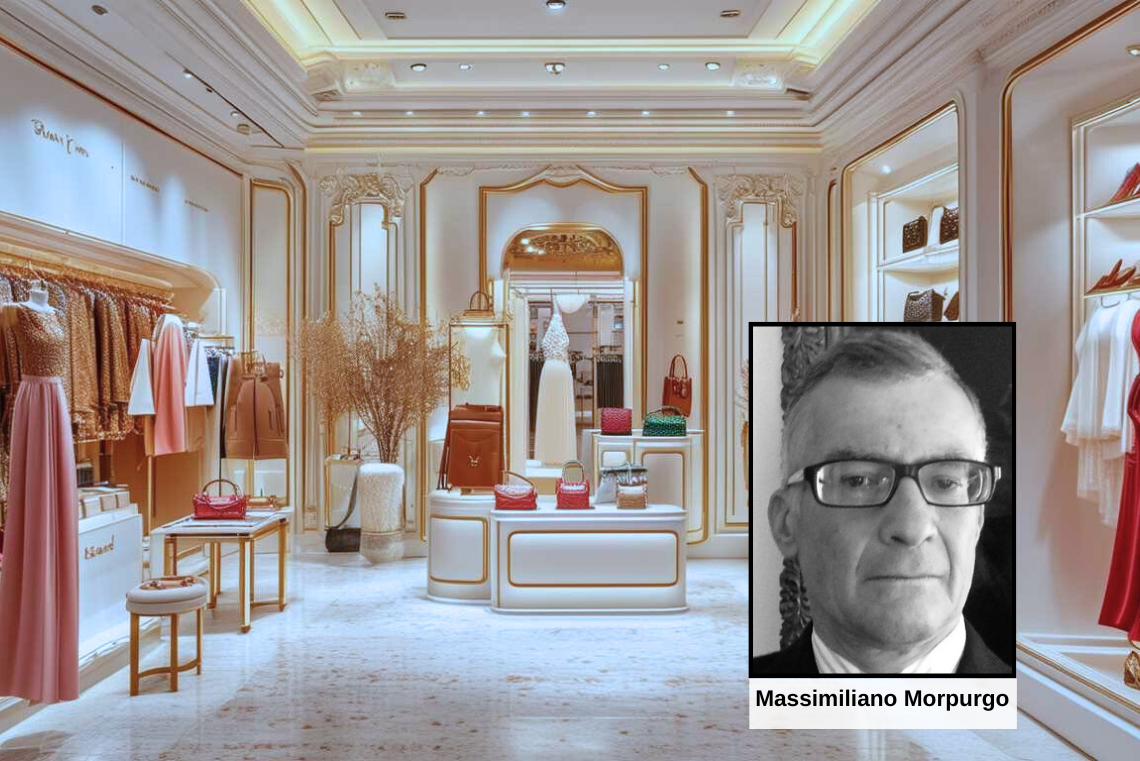
By Massimiliano Morpurgo, CDI Global Italy, Senior Advisor
Author:
Published:
2nd April 2025
Format:
Subject:
Industry:
Share:


