Czechia and Slovakia, Attractive Destinations for an Industrial Production
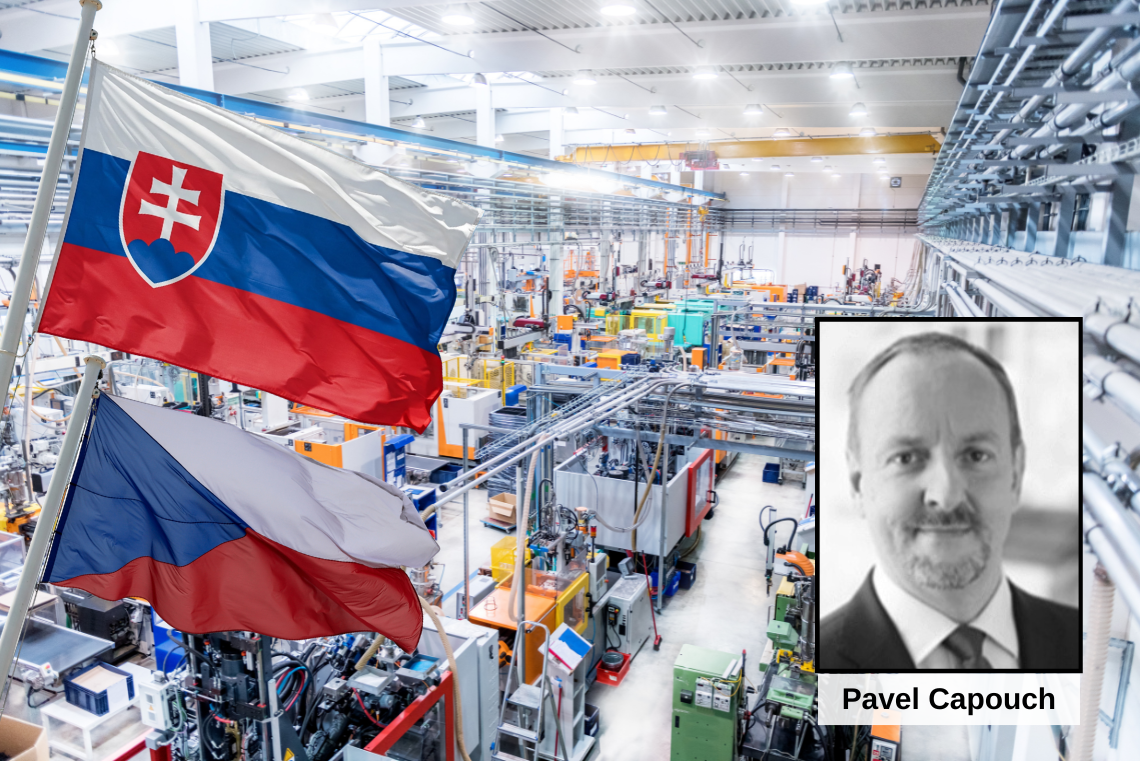
Czechia and Slovakia are both significantly industrialized countries that provide complex economies, high production capabilities, highly skilled workforces with still reasonable labor costs compared to Western countries, and proximity to key EU markets.
History
Czechia and Slovakia have a long industrial tradition. In the nineteenth century, Czechia was the industrial heart of the Austro-Hungarian Empire, to which both countries belonged at the time. After the establishment of Czechoslovakia in 1918, the newly formed country became one of the global leading industrial nations. Local brands like ČKD, Škoda, Baťa, and Vítkovice were globally respected industrial producers. While 40+ years under communist totality after World War II had a devastating influence on private property and innovation, the fundamental skills and production ability remained.
After 1989, when the totalitarian regime fell, both countries (independent since the dissolution of Czechoslovakia in 1993) quickly returned to offering highly skilled employees and high-end production capabilities. The entrepreneurship of Czech and Slovak businesspeople, together with significant foreign direct investment, helped establish robust production infrastructures in both countries capable of supplying not only EU markets but also overseas markets. Many companies continued their long histories through successful privatization, either by local or international investors. On the other hand, a huge number of new companies were established as greenfield projects by local entrepreneurs or as subsidiaries of foreign companies.
Present
Currently, both countries are significant, export-oriented economies considered highly complex. According to the Economic Complexity Index (ECI) for 2023, Czechia was ranked seventh and Slovakia fifteenth among all world countries by ECI Trade (Source: The Observatory of Economic Complexity).
This complexity is, and will be, considered the main advantage of both economies in a fast-changing world. Both countries are still able to offer lower labor costs compared to their main Western trade partners, especially Germany. The Czech economy is highly integrated with Germany’s industrial ecosystem through close trade relations and interconnected supply chains.
Automotive Sector: A Regional Powerhouse
In both countries, the automotive industry is a key pillar. Both car and car parts producers generate a significant part of GDP. In Czechia, the automotive industry generates about 10% of GDP, roughly 25% of industrial production, and accounts for 25% of total exports. In 2024, a total of 1.45 million cars were manufactured in Czechia. The key producer is the original Czech brand Škoda, now part of the Volkswagen Group, with three production facilities in Czechia. Hyundai and Toyota also have factories in the country.
Slovakia has been a long-term world leader by the number of manufactured cars per citizen. The share of automotive in GDP is about 11-13%, in industrial production is about 50%, and total exports reach about 45%. There are four production facilities currently in operation (Volkswagen, Stellantis, Kia, Jaguar Land Rover), and a fifth one (Volvo) will begin operations in 2026.
Both countries possess an extensive infrastructure of car parts manufacturers, supplying not only local car assembly plants but also global manufacturers. These suppliers are owned by both international corporations and local entrepreneurs.
Although the automotive industry across the EU faces headwinds, Czech and Slovak manufacturers are mostly performing well. This is a direct result of their flexibility, robust production capabilities and diversification of customers.
Defense as a Key Growth Driver
The war in Ukraine has changed the apparent stability of Europe. This event is surely but slowly reshaping mainstream EU politics, which now places greater emphasis on security and defense, leading to an increase in government spending in this area.
The defense and aerospace industries have been important parts of both Czech and Slovak industries since the beginning of their industrialization. They survived in good condition even during the communist era, when general industry otherwise lagged behind its Western competitors.
There are significant producers of defense equipment, radar systems, and aerospace components. Czechia is still one of the few countries in the world with the capability to produce complete aircraft. As in the automotive sector, the defense and aerospace industries have extensive supplier networks in both countries.
During the last decade, a couple of Czech defense companies began consolidating the market, first locally, and later globally. Currently, Colt CZ Group (originally Česká zbrojovka) and Czechoslovak Group are significant global players in their segments.
Engineering – A Traditional Strength
Engineering has been a key industry in both countries since industrialization. It remains very important today and underscores their high level of economic complexity. The production capabilities include high-end and cutting-edge products. The engineering sector has transitioned from traditional heavy industry to high-tech fields with high added value. For instance, Czech and Slovak companies possess significant expertise in electron microscopy and precision optics, nanotechnology and textile engineering, 3D printing and additive manufacturing, the semiconductor ecosystem, and energy engineering and turbines.
A significant strategic shift is occurring in the energy sector. With the massive investment in new nuclear blocks in Czechia and expertise of both countries in nuclear operation, the region offers a unique, specialized supply chain. Furthermore, the expansion of semiconductor manufacturing (e.g., onsemi's multi-billion-dollar investment) positions the region at the heart of the European high-tech value chain.
IT & Innovations
Beyond hardware, both nations have emerged as software and R&D hubs. The synergy between traditional engineering and a strong talent pool in AI, cybersecurity, and industrial automation makes the region an ideal location for Industry 4.0 applications.
Maximizing ROI through Strategic Complexity
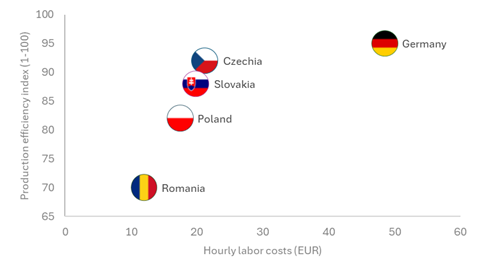
While Western Europe faces skyrocketing operational costs and Eastern Europe focuses on simple assembly, Czechia and Slovakia offer the ideal balance: Top-tier industrial complexity (Global Top 15) at approximately 45% of the labor cost of Germany. This makes the region the premier destination for high-tech manufacturing and R&D outsourcing in 2026.
Opportunities
A lot of entrepreneurs who founded their businesses in the 90s after the economic transformation from the period of communist totality are facing succession issues, which creates attractive business opportunities for investors looking for well-established companies with sound products or services and significant market positions.
The Succession Gap represents a unique entry point for Private Equity and strategic investors. Hundreds of mid-sized industrial champions (Mittelstand-style companies) with proven export records and EBITDA-positive operations are currently or would be soon seeking new ownership due to generational turnover, offering high-quality targets with significant scaling potential.
CDI Global CEE’s Prague office, covering both Czechia and Slovakia, is the premier partner for international investors seeking strategic acquisitions or production relocation. With over 25 years of M&A expertise in the region, our partners provide the local insight and transaction experience necessary to navigate these complex markets and secure high-value opportunities.
By Pavel Capouch, Managing partner at CDI Global CEE, Prague office
Author:
Managing Partner
Published:
19th January 2026
Format:
Subject:
Industry:
Share:


