The Cost of Doing Nothing: Missed Opportunities in African Investment
The biggest risk in Africa may not be investing — but failing to invest entirely
There is a kind of risk that never appears on a spreadsheet. It has no volatility index, credit rating or clearly defined downside. Yet it is one of the most expensive miscalculations a global investor can make: standing still while a continent transforms.
Africa is undergoing a structural shift that is reshaping global economic dynamics. Household spending has surpassed $2 trillion, supported by a rapidly expanding middle class. The continent represents the future of global demand with a current median age of just 19, and a majority population under 30. By 2050, one in four people globally will be living in Africa. These are not projections of a distant future, but characteristics of a present economic reality on the continent. The question for global capital is no longer whether Africa will matter, but whether investors will be positioned to participate in the continent’s growth and capitalise on its returns.
Still, investor perception is anchored in a narrow risk lens. The dominant African narrative focuses on political instability, currency volatility and infrastructure gaps. These risks are real and must be priced appropriately, and recent events reflect these challenges. In parts of West Africa, including Mali, Chad, Burkina Faso and Niger, repeated military interventions since 2020 have been accompanied by bans on opposition parties and the indefinite extension of transitional rule, deepening uncertainty over governance trajectories. In North Africa, Egypt and Tunisia continue to face foreign exchange shortages and inflationary pressure, intensified by constrained access to external funding and heavy reliance on imported food and energy. Across parts of Southern and East Africa, persistent gaps in transport and energy infrastructure increase operating costs and reduce productivity.
However, the risk framing is often extrapolated into a continent-wide sentiment discount that does not reflect the underlying diversity of African markets, and in doing so, obscures an important reality: risk and transformation are occurring simultaneously. Reform-oriented, relatively stable economies such as Rwanda and Uganda are recording GDP growth rates above 7%, more than double the global average of 2.6%. , In West Africa, investment is shifting from large acquisition-led deals toward infrastructure financing, venture capital and growth equity, signalling more diversified capital markets.
Deal activity is expanding beyond Africa’s big four investment hubs — Nigeria, South Africa, Kenya and Egypt — into Côte d'Ivoire, Senegal and Ghana, while Morocco continues to stand out for macro stability supported by sustained investment.7 Even frontier markets, including parts of the Sahel and resource-dependent economies, can support opportunistic strategies in critical minerals or logistics when paired with the right structures and local partners. Africa is not a single investment story, but a set of distinct markets moving at different speeds with strong structural momentum.
The gap between how an economy is perceived and how it is evolving carries an economic cost, reflected in the returns captured by investors willing to engage early. History provides a clear precedent: investors who entered Southeast Asia during the 1997-1998 financial crisis captured defining early-21st-century returns, while those who waited for “stability” found that much of the value had already been priced in, Similar dynamics were evident in Latin America and Eastern Europe. The lesson is not that risk should be ignored, but that timing itself is a form of risk management.
Hesitation in Africa is not caution — it is a choice to let others write the story.
The same dynamic is now visible in Africa, arguably at a larger scale. Institutional investors continue to allocate only a fraction of their emerging-market exposure to African assets — and the numbers bear this out. Between H1 2024 and H1 2025, Africa recorded a 42% decline in foreign direct investment inflows (see Figure 1), marking one of the most pronounced contractions among developing economies. At the same time, the continent accounts for only around 4% of global FDI inflows, compared with 13% in Latin America and the Caribbean and 44% in Asia.
Figure 1: Foreign Direct Investment (FDI) by Economic Grouping and Region $’bn, 2025 H1
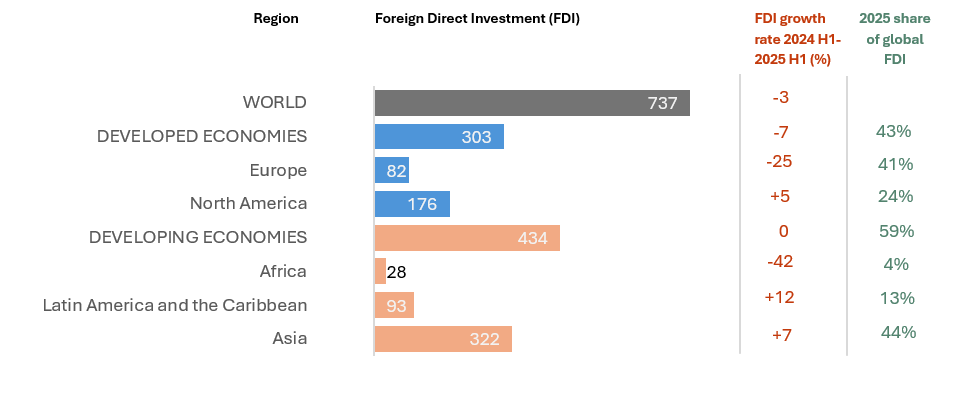
Source: Adapted from UNCTAD, 2025
However, the fundamentals tell a different story. Africa is increasingly ripe for greater capital deployment driven by economic integration, improved investor conditions and significant growth potential. The African Continental Free Trade Area (AfCFTA) is gradually lowering barriers across 54 economies, creating an integrated market of 1.4 billion consumers with a $3.4 trillion combined GDP, projected to more than double by 2050. This integration is reinforced by rapid growth in financial infrastructure, with the continent processing $1.1 trillion in mobile money transactions in 2024, a 15% increase from 2023 levels. , In addition, infrastructure projects in Africa historically record default rates of 5.5%, which is six to nine percentage points lower than rates in Asia and Latin America, suggesting that perceived risk often exceeds realised outcomes.
The infrastructure for this next phase of growth is already being built. In Morocco, renewable energy now accounts for nearly 40% of installed power capacity, with the country adding 192 MW of solar and wind capacity in 2025 alone. , Kenya has launched a $1.5 billion highway expansion programme and a National Infrastructure Fund targeting $11 billion for 10,000 kilometres of new roads, reinforcing its position as East Africa's logistics gateway. In Côte d'Ivoire, special economic zones such as the Plateforme Économique Industrielle d'Abidjan are attracting FDI through streamlined business setup processes and long-term operational support. These projects represent capital flowing into renewable power, cross-border logistics corridors and industrial zones where domestic demand and regional integration are underpinning robust pipelines. Taken together, this points to a continent where structural conditions for investment are strengthening, yet capital allocation remains comparatively limited.
The opportunity, then, is not to ignore risk, but to distinguish between risks that are real and risks that are being overstated. This is not an argument for indiscriminate investment. Success in Africa requires discipline, selectivity and strong local execution. The local partners, deal pipelines and institutional frameworks for managing risk exist, but the opportunity set is uneven and demands precision in market selection. As markets develop, information improves and pricing becomes more efficient, narrowing mispricing and eroding early-mover advantages.
But the case for engaging with Africa extends beyond risk-adjusted returns. Reframing African risk is about where and how global capital chooses to influence the next phase of economic transformation. Every dollar of productive investment has a direct bearing on job creation, trade competitiveness and resilience to climate shocks. In that sense, under-allocation to Africa represents a double missed opportunity: investors forgo attractive, diversifying returns, and the global economy loses momentum in one of the few regions where demographic and demand growth are structurally embedded. For institutions with climate, inclusion or "just transition" mandates, aligning capital with Africa's growth is therefore central to making those mandates real.
The biggest risk in Africa is not investing. It never was. The real risk lies in waiting too long to recognise a shift that is already underway.
by Hany Girishkumar | CDI Africa
[1] African Development Bank (AfDB). African Economic Outlook 2025.
[1] Africa Centre for Technology Studies (ACTS). Africa New Middle Class, December 2024
[1] United Nations. Young People’s Potential, the Key to Africa’s Sustainable Development.
[1] World Bank. Africa Overview 2025.
[1] Inclusive Peace. 2026. Praetorianism on the march in the Sahel.
[1] Italian Institute for International Political Studies. 2026.
[1] The North Africa Post. 2026. IMF keeps Tunisia 2026 growth forecast at 2.1%, warns of external shocks.
[1] ISS Africa. 2026. Large Infrastructure. Thematic Futures.
[1] Stears Data. The Macroeconomic Signals Shaping the Month Ahead, 2026.
[1] UNCTAD. 2025. Global growth expected to slow to 2.6% through 2026.
[1] Radelet, S., & Sachs, J. 1998. The East Asian Financial Crisis: Diagnosis, Remedies, Prospects.
[1] Bloomberg. Crisis to Crisis: What Asia Learned From the Financial Chaos of 1997.July 2022.
[1] UNCTAD. 2025. Foreign direct investment trends in emerging markets: A focus on Africa.
[1] UNCTAD. 2025. Global foreign investment falls 3% in first half of 2025, hitting industry and infrastructure.
[1] UNECA. AfCFTA Progress Report 2025.
[1] GSMA. Mobile Money Impact Report 2024.
[1] Ecofin Agency. 2024.
[1] Africa Practice. 2025 The weighted vest hindering African development.
[1] Energetica India Magazine. 2026. Morocco Expands Renewables as Solar and Wind Drive 2025 Growth.
[1] Zawya. 2026. Morocco adds 192MW renewable capacity in 2025.
[1] International Trade Administration. 2025. Kenya Infrastructure Fund and Road Expansion.
[1] Africa For Investors. 2026. Plateforme Economique Industrielle d'Abidjan. Ivory Coast, Special Economic Zone.


