Human Blind Spots in MA: When Human Dynamics Become Execution Risk

Mergers and acquisitions remain among the most powerful tools for corporate growth, portfolio transformation and value creation. Yet despite increasingly sophisticated financial, legal, tax, commercial and operational due diligence, many transactions still fail to deliver the value anticipated at signing.
Failure rates vary depending on how success is measured—shareholder returns, synergy realization, accounting performance, strategic objectives or executive assessments. While no single statistic captures M&A performance, research consistently shows that a significant proportion of acquisitions fall short of expectations.
Most explanations focus on strategy, valuation, integration planning or market timing. These are critical, but another factor often remains underexamined before closing: the collective execution capacity of the leadership system responsible for delivering the investment thesis.
This article introduces a Human Capital Intelligence perspective and presents PHCI® (Paralipse Human Capital Intelligence) as a framework for making this human execution layer visible before transactions close.
The issue is not whether people matter in M&A—experienced dealmakers already know they do. The more important question is whether leadership dynamics can be systematically assessed as execution risk before they appear in post-deal performance.
1. What Research Tells Us About M&A Performance
Three decades of research suggest that traditional deal variables explain only part of acquisition outcomes. King, Dalton, Daily and Covin (2004), for example, found that widely studied acquisition factors account for only a limited share of post-acquisition performance, implying that important determinants remain insufficiently understood.
Research on culture reaches similar conclusions. Stahl and Voigt's meta-analysis showed that cultural differences influence socio-cultural integration, synergy realization and shareholder value in different ways, while Cartwright and Cooper emphasized that cultural compatibility affects organizations' ability to combine effectively.
The evidence does not suggest that people issues explain every failed acquisition. Rather, it indicates that human dynamics shape how strategic, operational and financial plans are ultimately executed.
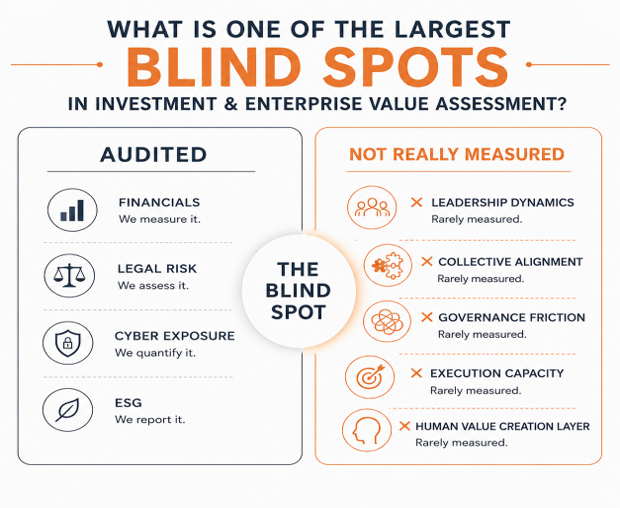
2. Human Blind Spots in M&A
Human blind spots rarely appear as obvious red flags before closing. Instead, they emerge through leadership alignment, decision-making, governance, authority distribution and the organization's ability to translate strategy into execution.
Traditional due diligence effectively evaluates financial performance, legal exposure, tax structures, market position and operations. It is less equipped to determine whether the leadership team can collectively execute the value creation plan.
This creates a gap between the transaction model and its execution. A deal may be strategically sound and financially attractive while still carrying significant hidden execution risk.

3. Why Human Dynamics Are Difficult to Assess Before Closing
Before closing, leadership access is naturally limited. Management presentations are carefully prepared, narratives are controlled and internal tensions often remain invisible. Leadership alignment may appear stronger than it is, governance issues may be understated and transformation readiness is frequently assumed rather than tested.
These factors usually become visible only when organizations must execute under pressure. Following closing, leadership teams must make faster decisions, adapt to new governance structures, clarify priorities and sustain execution momentum. It is often at this stage that previously hidden weaknesses begin affecting performance.
4. Human Execution Risks
The principal human risks affecting post-deal performance are not simply cultural concerns but execution conditions that influence how value creation plans become operational reality:
- Leadership misalignment: unclear priorities, roles or decision rights slow execution.
- Weak decision quality: delayed or inconsistent decisions reduce integration speed and effectiveness.
- Governance friction: new reporting structures and accountability mechanisms create unnecessary complexity.
- Cultural integration risk: trust, collaboration and information sharing may deteriorate.
- Identity fragmentation: employees continue identifying with legacy organizations rather than the combined enterprise.
- Limited collective execution capacity: capable individuals do not necessarily function as an effective leadership system.
- Insufficient transformation readiness: leadership may struggle to absorb the pace and complexity of change required after acquisition.
5. When Human Risk Becomes Economic Risk
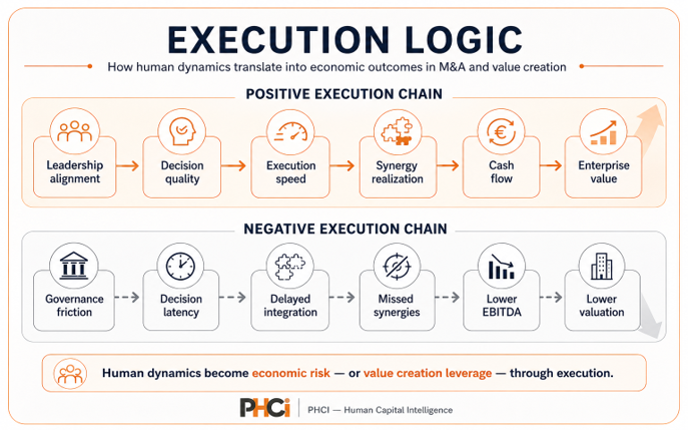
Human risk becomes economic risk when it disrupts execution.
Weak alignment creates inconsistent priorities. Poor decision-making slows implementation. Governance friction reduces accountability. Limited collective execution delays synergy capture and transformation.
These dynamics directly influence execution speed, reliability, integration quality and ultimately financial performance. Over time, they can affect cash flow, EBITDA delivery and enterprise value.
If execution capacity influences value creation, the logical next step is to translate these dynamics into indicators that investors, boards and advisers can assess alongside traditional financial metrics.
Execution logic

6. Human Due Diligence: Making Execution Conditions Visible
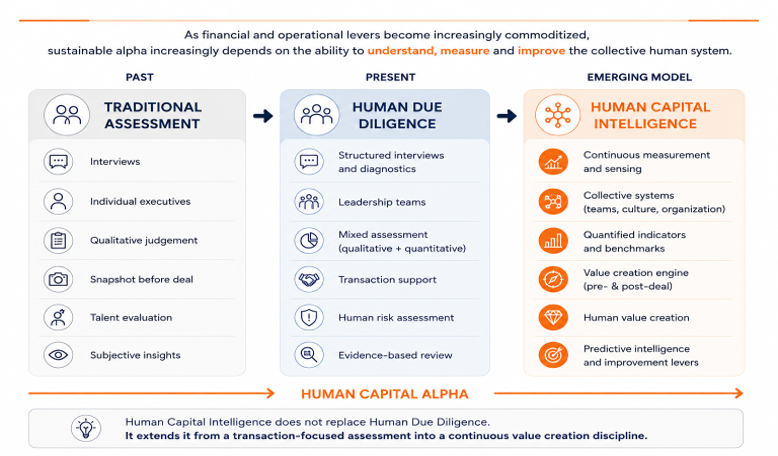
Human Due Diligence should complement—not replace—financial, legal, commercial and operational due diligence.
The essential question is not simply:
"Are these capable leaders?"
It is:
"Can this leadership system execute the value creation plan under real-world conditions?"
Strong individual leaders do not automatically create strong collective execution. Conversely, leadership teams with visible tensions may still possess sufficient discipline and alignment to deliver results.
Experienced investors often evaluate management quality through presentations and executive interviews. Such judgment remains indispensable but is frequently informal, difficult to compare across transactions and only loosely connected to execution risk.
Human Due Diligence seeks to make these assessments more systematic, transparent and financially interpretable.
7. From Human Due Diligence to Human Capital Intelligence
The next step is to move beyond qualitative observation toward structured Human Capital Intelligence.
In M&A, leadership should be assessed through execution indicators such as:
- leadership alignment;
- decision quality;
- governance effectiveness;
- collective execution capacity; and
- transformation readiness.
PHCI® was developed to assess this layer by analysing the collective execution capacity of boards, executive committees, portfolio company leadership teams and post-merger integration teams.
Rather than treating human capital simply as a workforce issue, PHCI® views leadership as an execution system whose effectiveness influences the success of the investment thesis.
8. Translating Human Dynamics into Financial Indicators
For human analysis to support investment decisions, it must connect with financial language.
This does not reduce people to financial variables. Instead, it recognizes that collective execution capacity already affects financial outcomes through execution speed, reliability, transformation capability and delivery of strategic objectives.
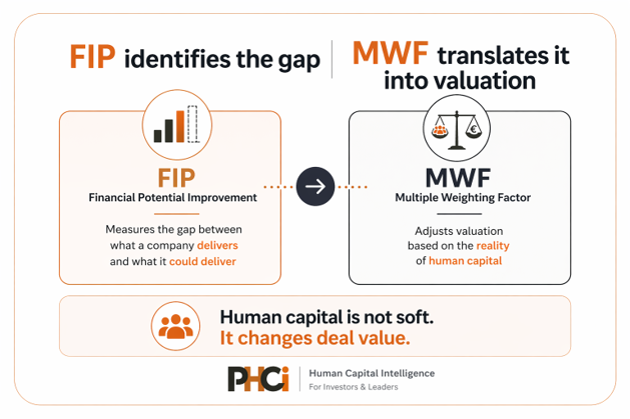
Two concepts illustrate this connection:
- FIP (Financial Improvement Potential): estimates the performance improvement that stronger collective execution could generate.
- MWF (Multiple Weighting Factor): provides a valuation perspective by considering how leadership execution capability influences confidence in the value creation plan.
The objective is not to replace financial modelling but to make human execution capacity more measurable and useful for decision-making.

9. Human Capital Alpha
In investment management, alpha represents performance beyond market expectations. A similar principle can be applied to leadership.
Some leadership systems consistently create greater value because they execute more effectively. They align faster, make better decisions, reduce governance friction, coordinate action more efficiently and adapt more successfully to transformation.
This is the concept of Human Capital Alpha: the additional value created through superior collective execution.
Human dynamics are not the sole driver of performance. Strategy, markets, financing, operations and timing all remain fundamental. But leadership execution can amplify—or weaken—the value creation potential of any transaction.
Human capital therefore becomes more than a cost, a resource or a cultural consideration. It becomes a strategic source of execution advantage.

10. Implications for Dealmakers and Investors
For dealmakers, this approach helps identify execution risks before they become post-closing obstacles.
For investors, it offers a more structured assessment of whether leadership can deliver the investment thesis.
For advisers, it complements traditional due diligence with a clearer understanding of execution capability.
For integration teams, it highlights where misalignment, governance friction, weak decision-making or limited transformation readiness could impede performance.
For boards, it sharpens a fundamental question:
Is the leadership system truly prepared to execute what the transaction requires?
The objective is not to make M&A more complex but to illuminate a critical source of execution risk that traditional due diligence often overlooks.
Conclusion
CDI Global was founded in 1973 by Bo Hjelt, a business leader with firsthand experience of numerous transactions. He recognized early on that value creation in M&A depends on far more than assets, financial performance, or identified synergies. It also depends on the strategic fit and human fit between the companies involved.
Bo was a pioneer in understanding that a company’s value is fundamentally linked to its people—its executives, experts, sales teams, and operational staff. Their capabilities, relationships, motivation, and ability to execute are often decisive to the success and long-term sustainability of a transaction.
This perspective has shaped CDI Global’s approach for decades. We have long considered the identification of key personnel and the assessment of retention and turnover risks to be an integral part of due diligence. This is particularly critical when transactions involve overlapping roles, organizational restructuring, or the alignment of compensation and benefits. These people-related factors can materially affect integration costs, organizational stability, and the time required to realize anticipated synergies.
Our extensive experience in cross-border transactions has further reinforced the importance of cultural and management compatibility. Misalignment can result in disengaged teams, declining productivity, loss of critical talent, and ultimately weaker transaction outcomes. Conversely, a strong organization, aligned leadership, and committed teams can significantly accelerate the execution of the strategic plan and the realization of value.
Human capital should therefore not be viewed simply as an HR consideration. It is a fundamental driver of valuation, risk, integration, and value creation in M&A.
Over time, due diligence has evolved well beyond financial analysis to encompass commercial, operational, cybersecurity, ESG, and technology considerations. Human Due Diligence is the next logical evolution of this process.
As value creation increasingly depends on organizational transformation and execution—not simply on the transfer of assets—understanding an organization’s leadership, talent, culture, and collective capacity to deliver the strategy has become a strategic necessity.
By Thierry Gibert and Jérôme Jeanclos
Author note
Jérôme Jeanclos is the founder of PARALIPSE and the creator of PHCI® (Paralipse Human Capital Intelligence), a proprietary framework that assesses the collective execution capacity of leadership teams in strategy, M&A, private equity and transformation contexts.
PHCI measures leadership alignment, governance effectiveness, collective execution risk and organizational capacity to deliver value.
By making the human dimension of execution visible and measurable, PHCI advances Human Due Diligence as a complementary discipline alongside financial, legal, commercial and operational due diligence.
Selected references
· Cartwright, S., & Cooper, C. L. (1993). The role of culture compatibility in successful organizational marriage. Academy of Management Executive, 7(2), 57–70.
· King, D. R., Dalton, D. R., Daily, C. M., & Covin, J. G. (2004). Meta-analyses of post-acquisition performance: indications of unidentified moderators. Strategic Management Journal, 25(2), 187–200.
· Stahl, G. K., & Voigt, A. (2008). Do cultural differences matter in mergers and acquisitions? A tentative model and meta-analytic examination. Organization Science, 19(1), 160–176.
· Tajfel, H., & Turner, J. C. (1979). An integrative theory of intergroup conflict. In W. G. Austin & S. Worchel (Eds.), The Social Psychology of Intergroup Relations.
Author:
Managing Partner
Published:
16th October 2026
Format:
Subject:
Industry:
Share:


