Convergence Of Autonomous Technologies And Their Impact On Advanced Air Mobility In Aerospace & Defense
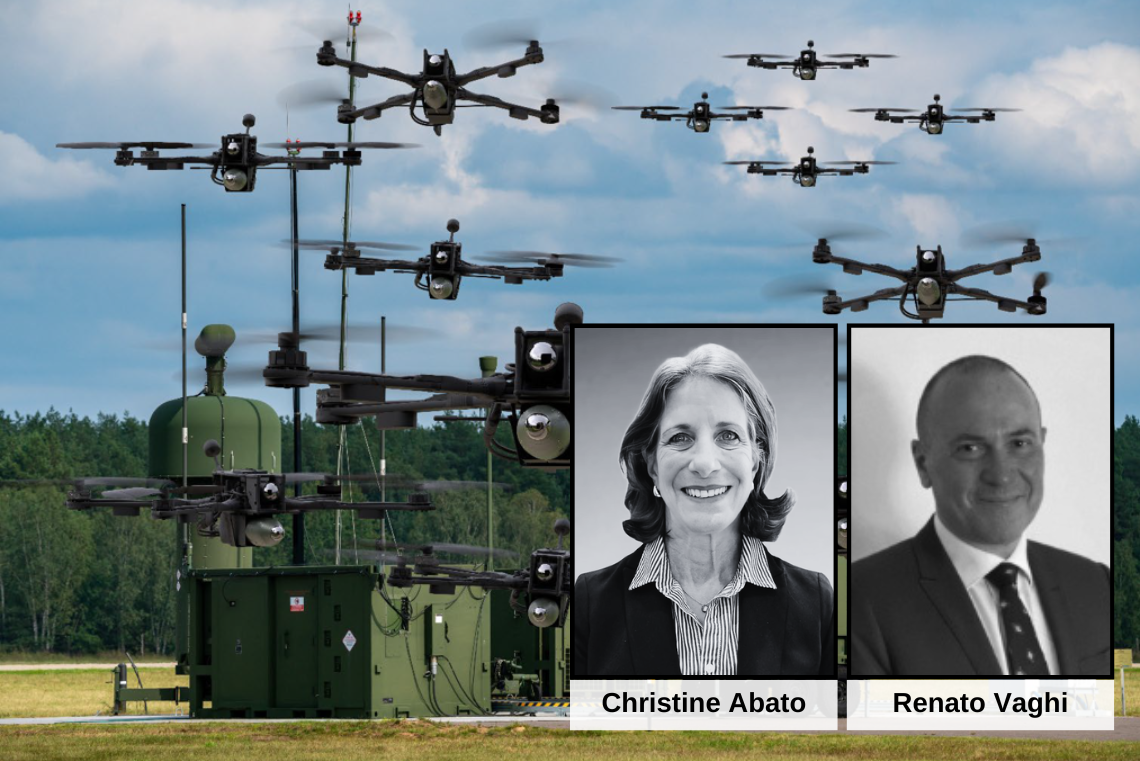
How LiDAR, Vision Guidance, SLAM, RFID, Magnetic Sensors, and MEMS are converging to redefine modern conflict and reshape the Aerospace & Defense investment landscape.
M&A KEY INSIGHT - FOR LARGE A&D COMPANIES: The gap between what internal roadmaps can deliver and what the battlefield is demanding is widening faster than organic R&D can close it. Large defense primes face a build-versus-buy imperative. The innovation cycle in autonomy is compressing from years to months. Acquiring proven autonomy-stack companies is now faster and more reliable than internal development programs.
EXECUTIVE SUMMARY: THE NEW CALCULUS OF CONFLICT
BATTLEFILED IMPACT
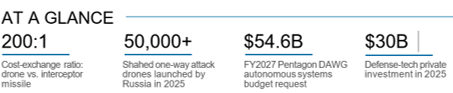
Modern warfare has a new economic logic, and it is severe. A Shahed-type one-way attack drone, produced at scale in Russia for an estimated $20,000 to $50,000, can force a defender to expend a Patriot interceptor missile priced at roughly $4M per shot. That is a cost-exchange ratio of up to 200-to-1 in the aggressor’s favor, and the math only worsens as target values rise. A loitering munition costing tens of thousands of dollars can disable a radar or sensor node worth hundreds of $M. [1]
According to data compiled by the Center for Strategic and International Studies (CSIS), Russia launched more than 14,700 one-way attack drones against Ukraine between September 2022 and December 2024. By 2025, weekly Shahed launches had climbed from a baseline of roughly 75 to more than 900, with over 50,000 drones launched across the year. That represents approximately five times the prior year’s volume. [1][2]
Ukraine has responded in kind, producing roughly 2M drones in 2024 and targeting 4-5M in 2025. Beyond Ukraine, the June 2025 Israel-Iran conflict confirmed that AI-enabled autonomous drone warfare has become a defining feature of modern great-power competition: Israeli forces deployed autonomous drone swarms coordinated with AI targeting systems to suppress Iranian air defenses, while Iran launched waves of its own Shahed-derived platforms in saturation attacks designed to overwhelm layered defenses. [4][21]
This is not a story about using inexpensive, unsophisticated hardware against ultra-sophisticated and expensive technology. It is a story about convergence. Six core Autonomous Mobile Robot (AMR) technologies have matured simultaneously and are now reinforcing one another: LiDAR sensing, vision guidance, SLAM navigation, RFID-enabled coordination, magnetic sensing, and MEMS-based inertial systems. Together, they are making drones, ground robots, and precision guidance systems exponentially more capable, more autonomous, and cheaper to produce.
ACROSS PLATFORMS
Six core Autonomous Mobile Robot (AMR) technologies have matured simultaneously and are now reinforcing one another across platforms: LiDAR sensing, vision guidance, SLAM navigation, RFID-enabled coordination, magnetic sensing, and MEMS-based inertial systems.
KEY INSIGHT The defining economic problem of modern conflict is a cost-exchange ratio that consistently favors the attacker. Solving it requires affordable autonomous mass, not more expensive individual platforms.
THE CORE TECHNOLOGY CONVERGENCE
The leap in autonomous capability is not the product of any single invention. It reflects the simultaneous maturation of six distinct technology domains, each now advancing the others. Better sensors generate richer data. Better compute turns that data into real-time decisions at the edge. Better algorithms let systems navigate, classify, and coordinate under jamming, terrain masking, or communications loss. The cumulative effect is exponential, not linear. [17]
Laser and LiDAR
LiDAR has moved from a premium payload to a compact, power-efficient sensing layer compatible with small drones and mobile robots. MarketsandMarkets identifies aerospace and defense as a fast-growing vertical for MEMS LiDAR, driven by demand for precise navigation, surveillance, and obstacle detection in reduced form factors. The driver is a combination of MEMS miniaturization, falling unit costs, and improved onboard processing. Solid-state LiDAR now enables low-altitude terrain following, autonomous landing, urban and indoor navigation, and real-time 3D mapping for logistics drones and uncrewed ground systems. A drone that can see in three dimensions without GPS is a fundamentally different weapon than one that cannot. [18]
Vision Guidance
Edge AI and compact neural processing units have made object recognition and target-lock functions feasible on small, low-power platforms. Reuters reported that Ukrainian operators are deploying AI-assisted targeting systems that lock onto a target’s visual signature through an onboard camera and continue the strike autonomously even after communications are disrupted. This is a direct counter to dense electronic warfare environments where GPS-dependent drones fail. [14] Israel’s Operation Rising Lion in June 2025 demonstrated this capability at scale: the IDF’s AI targeting systems, including the Gospel and Lavender platforms, fused drone footage, signals intelligence, and satellite imagery to refresh target banks in near-real time, enabling an unprecedented tempo of autonomous strike operations. [21]
SLAM: Simultaneous Localization and Mapping
GPS can no longer be treated as assured in high-end conflict. SLAM allows systems to build a real-time map of an unknown environment while tracking their own position within it, using fused inputs from cameras, LiDAR, inertial units, and magnetic sensors. DARPA’s Adaptable Navigation Systems program is explicitly focused on delivering GPS-quality positioning through alternative sensors and reconfigurable architectures. [7] Its companion Micro-PNT program targets miniature inertial sensors capable of precise self-contained navigation when satellite signals are denied. [6]
RFID Tags and Tracking
RFID and ultra-wideband tracking allow autonomous platforms to identify one another, prevent collisions, and execute complex maneuvers without a central command hub. In defense logistics, RFID supports asset awareness, robotic retrieval, and cross-platform coordination across supply chains and maintenance nodes. The Pentagon’s explicit budget priority for contested logistics alongside autonomy platforms reflects a growing understanding that autonomous systems are movers as much as shooters. Machine-readable identity is foundational to making that work. [8]
Magnetic Sensors
Improvements in compact magnetometers and sensor fusion have made magnetic sensing a reliable, low-cost layer for orientation and heading maintenance in electromagnetically contested environments. When fused with SLAM and inertial data, magnetic sensors provide an unjammable positional reference that supports mission continuity when other signals degrade. In gyro-stabilized navigation packages and hypersonic guidance systems, this resilience layer is not optional. It is essential. [6][7]
Inertial Sensors and MEMS
Inertial sensors accounted for 31.75% of the drone sensor market in 2025, according to Mordor Intelligence, reflecting their foundational role across every airframe category. [19] DARPA’s Micro-PNT program makes the defense case directly: GPS dependence is a critical vulnerability, and miniature inertial sensors are the path to precise guidance in GPS-denied conditions. [6]
These same advances in MEMS-based stabilization and navigation are now beginning to transform Advanced Air Mobility and gyrocopters for personal aviation. Because Autogyros, for example, have a rotor that autorotates passively, the platform is inherently more stable than helicopters, but requires dedicated training for take-off and landing. Automatic Flight Control Systems and the convergence of these six technologies not only enhances navigation and flight stability, but also materially reduces the skill threshold required to fly them.
As MEMS inertial systems, digital heading hold, and autonomous attitude correction are integrated, the skill threshold for gyrocopter operation drops materially. Modern gyrocopter manufacturers report that flight training now requires as few as 15 hours, and the integration of digital flight stabilization is reducing that further. The result is a personal aerial platform that is genuinely approachable for a wider range of non-expert operators.
KEY INSIGHT Advances in MEMS inertial sensing, SLAM, and digital stabilization are quietly making gyrocopters easier to fly than at any point in their history, opening a credible path to mass-market personal aerial mobility
IMPACT ON THE A&D LANDSCAPE
Unmanned Aerial Systems and Swarms
The convergence of these technologies has produced a new class of aerial platform: autonomous, vision-guided, and capable of continuing a mission after link loss. Ukraine has become the most intensive real-world test environment for this technology in history. The country produced approximately 2M drones in 2024, with 96.2% manufactured domestically, and by 2025 was delivering roughly 200,000 drones per month to frontline troops, up from 20,000 a month the prior year. [4] Ukraine produced more drones in a single year than the United States has produced across its entire recorded drone acquisition history. [16]
In December 2024, Ukrainian forces conducted their first fully unmanned military operation near Lyptsi, combining reconnaissance and strike drones in a single automated kill chain without a human operator in the execution loop. [4] Russia responded with fiber-optic-controlled drones in the Kursk region. Because these drones are guided by a physical wire rather than a radio signal, they are completely immune to electronic jamming. [3] The Israel-Iran theater has reinforced these lessons. Iran launched over 300 drones and ballistic missiles against Israel in April 2024, forcing the activation of every layer of Israel’s multilayered air defense.
By June 2025, during Operation Rising Lion, Israel had deployed AI-coordinated drone swarms capable of suppressing Iranian air defenses before conventional strike aircraft arrived. Iran has since been observed adapting its own saturation tactics, flying drones at lower altitudes and in larger waves, drawing directly from lessons absorbed from Russia’s campaign in Ukraine. [21][22]
KEY INSIGHT Drone warfare is no longer a single-theater story. Ukraine, Israel-Iran, and the Red Sea have each independently validated the cost-exchange problem and the operational effectiveness of autonomous, AI-guided systems.
Ground Robotics and Battlefield Logistics
Both Ukraine and Russia are deploying small autonomous and semi-autonomous ground robots for logistics, mine detection, casualty evacuation, and kamikaze roles. The emphasis on both sides is on cheap, attritable systems that can absorb risk without exposing personnel. [3]
The Pentagon’s FY2027 budget underscores the priority: the Defense Autonomous Warfare Group (DAWG) received $225.9M in FY2026 and has a requested FY2027 allocation of up to $54.6B, a more than 24,000% increase that confirms autonomy investment now extends well beyond aerial platforms. [8]
Gyros and Inertial Navigation
Gyroscopic and inertial navigation systems are the quiet enablers of this transformation. In precision strike, loitering munitions, maritime drones, and hypersonic platforms, performance depends on maintaining accurate orientation and positioning under stress. DARPA’s Micro-PNT and PINS programs both underscore that next-generation navigation must function without GPS at dramatically reduced size, weight, and cost relative to legacy systems. [6][7] That requirement is now propagating into advanced air mobility broadly, where autonomous aircraft must navigate through urban clutter, adverse weather, and communications loss with the reliability expected of manned platforms. Advances in digital stabilization are simultaneously making manned gyrocopters significantly easier to operate, reducing the pilot-skill barrier and expanding the addressable market for personal aerial transportation.
The Red Sea and the Cost-Exchange Problem
In the Red Sea, U.S. destroyers used interceptors priced at approximately $2.1M each during engagements against Houthi drones and missiles, producing single-day interception bills estimated above $17M for a single engagement. [15] The Foreign Policy Research Institute (FPRI) documented a parallel problem in the June 2025 Israel-Iran conflict: the U.S. fired approximately a quarter of its entire THAAD interceptor stockpile during less than two weeks of combat, a burn rate that exceeds the most aggressive annual production capacity by 50%. These are not isolated data points. They are structural signals that the economics of attritable mass have permanently shifted the terms of modern air warfare. [22]
KEY INSIGHT The Red Sea and the Israel-Iran conflict both confirm that defensive interceptor inventories cannot be replenished as fast as they are consumed against cheap autonomous threats. Offensive autonomy is, for now, structurally cheaper than the defense.
STRATEGIC IMPLICATIONS FOR A&D
Procurement is tilting toward affordable mass. The U.S. Army plans to acquire at least 1M drones over the next two to three years, according to Reuters. [12] The FY2027 Pentagon budget contemplates $13.4B for autonomous systems and $3.1B for counter-drone capabilities, both representing sharp year-over-year increases, with tens of $B more proposed for the DAWG. [8] The winner in this environment is not the company that builds the most capable individual platform. It is the company that can combine low-cost manufacturing with defensible autonomy software, resilient navigation, and scalable mission system integration.
Autonomy is shifting from experimentation to programmatic acceleration. The Replicator initiative, launched in 2023 to field thousands of attritable systems by August 2025, delivered hundreds of drones and put thousands more on contract. [9][11] Its successor, the Defense Autonomous Warfare Group, has moved toward larger one-way attack platforms, counter-drone systems, and live wargaming exercises. [10] Pentagon CTO Emil Michael summarized the mandate plainly: dominant small drones, dominant large drones, and a robust counter-drone program. Acquisition logic is shifting from long-cycle, low-volume programs to modular, software-defined systems with compressed upgrade cycles. Capital is flowing at scale, and acquisition is accelerating. Investors poured $30B into defense technology in 2025, according to Reuters. Counter-drone radar firm Chaos Industries raised $510M at a $4.5B valuation in late 2025. [13]
Traditional prime contractors are increasingly acquiring disruptors rather than competing with them. Anduril, Shield AI, and their peers are no longer peripheral to the defense ecosystem.
For large A&D incumbents, the strategic calculus is direct: the gap between what internal roadmaps can deliver and what the battlefield is demanding is widening faster than organic R&D can close it. Sensor fusion, autonomy middleware, counter-UAS, inertial navigation, and robotic logistics represent the highest-conviction M&A targets in the sector. For an investment bank advising defense and technology clients, the mandate is clear: identify which autonomy-stack companies possess defensible IP, operational data, and government relationships that a prime contractor or sovereign fund cannot replicate organically, and position those assets for strategic transactions before the market reprices them. [17]
KEY INSIGHT Large defense primes face a build-versus-buy imperative. The innovation cycle in autonomy is compressing from years to months. Acquiring proven autonomy-stack companies is now faster and more reliable than internal development programs.
CONCLUSION: THE 2030 HORIZON
Over the next three to five years, the distinction between drone and aircraft will continue to blur. The mosaic warfare model, in which a single human operator coordinates a constellation of 20 to 50 autonomous nodes, is no longer a concept paper. It is a live wargaming objective at the highest levels of the U.S. military and an operational reality in Ukraine and the Middle East. [10][20]
The six technologies described in this paper are deployed, battle-tested, and improving at a pace that would have seemed implausible five years ago. Ukraine’s design-to-deployment cycles now complete in days. Israel’s AI targeting platforms were refreshing strike banks in near-real time during active combat operations. Iran is adapting saturation tactics that originated in Russian doctrine and were honed against Ukrainian and Israeli defenses. Each of these theaters is generating operational data that will shape procurement, doctrine, and investment for the next decade. [3][4][21]
For investors and executives, the strategic imperative is clear. Competitive advantage in advanced air mobility and A&D broadly has migrated from the hardware shell to the autonomous brain. The decisive edge belongs to the force, and to the industrial base, that can sense, decide, move, and adapt faster at the lowest sustainable cost per effect. The M&A opportunity that follows from that transition is among the most significant in the history of the defense sector. [17]
About CDI
CDI Global’s international reach provides distinctive advantages for multinational clients. CDI Global has successfully partnered with and collaborated with clients around the world, in vertical sectors that span virtually every major industry. Our executive team works collaboratively to meet your strategic goals and our success is built on the long-term relationships we develop, providing broader insight and opportunities for our clients. We are committed to conducting all of our business activities with confidentiality, respect and integrity.
BY: Christine Abato and Renato Vaghi
Sources:
1. CSIS - Calculating the Cost-Effectiveness of Russia’s Drone Strikes
2. CSIS - Drone Saturation: Russia’s Shahed Campaign
3. CSIS - Russia-Ukraine Drone War: Innovation on the Frontlines and Beyond
4. CSIS - Ukraine’s Future Vision for AI-Enabled Autonomous Warfare
5. CSIS - Russia-Ukraine War in 10 Charts
6. DARPA - Micro-PNT: Micro-Technology for Positioning, Navigation and Timing
7. DARPA - Adaptable Navigation Systems (ANS)
8. DefenseScoop - DOD Moves to Make Its Largest-Ever Investment in Drones
9. DefenseScoop - DOD Replicator: Successful Transition, Lingering Questions
10. Breaking Defense - Biden-Era Replicator Lives On as DAWG
11. Congressional Research Service - DOD Replicator Initiative
12. Reuters - U.S. Army to Buy 1M Drones in Major Acquisition Ramp-Up
13. Reuters - Counter-Drone Radar Firm Chaos Raises $510M in Defense Tech Boom
14. Reuters - Ukrainian Drone Pilots Look to AI for Battlefield Edge
15. Forbes - Destroyers Shot Down 24 Houthi Missiles and Drones: That’ll Be $17M
16. Hudson Institute - Impact of Drones on the Battlefield: Lessons of the Russia-Ukraine War
17. McKinsey - Future Defense Tech: Multidomain Stacks to Build Affordable Mass
18. MarketsandMarkets - MEMS LiDAR Market Revenue Trends and Growth Drivers
19. Mordor Intelligence - Drone Sensor Market Size, Share & Industry Report, 2031
20. Brookings Institution - Replicator and Beyond: The Future of Drone Warfare
21. Jerusalem Post - Artificial Intelligence on the Battlefield in 2025
22. FPRI - Shallow Ramparts: Air and Missile Defenses in the June 2025 Israel-Iran War
23. AeroTime - The Autogyro Revival: A New Spin on Rotorcraft Tech
This document is prepared by Merit Investment Bank for informational purposes only and does not constitute investment advice or a solicitation to buy or sell any security. Securities offered through Finalis Securities LLC, Member FINRA/SIPC. Merit Investment Bank and Finalis Securities LLC are separate, unaffiliated entities.
Published:
7th July 2026
Format:
Subject:
Industry:
Share:


